step 3:
select a strategy

Selecting a strategy is the next step you need along the problem solving path. Once you become more familiar with various strategies, selecting the correct strategy for each problem will become easier as you recognize familiar patterns.
There are many types of strategies that can be used to solve a problem. There are two general strategies: Algorithm and Heuristic.
|
Algorithms
Using an algorithm is a type of strategy in which uses "a specific sequence of steps that guarantees a correct solution" (Ormrod, 2014, p. 137). It is like a set of rules that can be followed or a cookbook recipe. This particular strategy fits better with solving well-defined problems. Unfortunate, they cannot solve ill-defined problems because those types of problems do not necessarily have one answer someone can find a specific method to solve with. |

|

|
Heuristics
Using heuristics is a type of strategy that utilizes a lot of rules-of-thumb and is not as straightforward as algorithms. There is not a specific set of instructions that can be utilized. Despite this, it can be used to solve both types of problems, making this process more flexible. However, a solution is not guaranteed with this method. (Nietfeld, 2015). |
Some examples are trial & errors, means end analysis, analogy, and working backwards.
TRIAL AND ERROR uses a method in which repeated attempts to solve a problem are made until a solution has been found. Although it is the most frequently used strategy, it is the least efficient of the four examples . Trial and error can work if no other methods are apparent, but oftentimes, there are more efficient methods to be used.
MEANS END ANALYSIS is a method in which a problem is broken down into several smaller problems or parts. Then, each part is solved before moving on to the next part of the problem. This tends to be the method expert problem solvers use more often and is particularly efficient.
Using ANALOGIES is another method that can be use. It is when you relate the current problem you are working on to another one you have previously seen, such as a worked out example or another problem you once solved. Sometimes, spotting the relationships between two problems is difficult, but always keep in mind if the current problem looks familiar.
WORKING BACKWARDS is a method where you either have the goal or solution already (or an idea of what it should be) and figure out how to work towards it. Sometimes, it is possible to judge a problem and see what solutions will satisfy it. That is when you can work from that solution towards the beginning of the problem.
When solving a physics problem, a variety of these general solutions can be applied. However, it might take some practice to determine which strategies will work best for each case.
In continuing Dr. Simanek's (2004) steps to solving a physics problem, selecting a strategy based on the information you were given is stressed.
In continuing Dr. Simanek's (2004) steps to solving a physics problem, selecting a strategy based on the information you were given is stressed.
6. Consider the situation carefully. [This requires thinking about it.] List the principles that applies to this problem. Double-check: are you sure they apply? Write down the principles in the formula form.
7. Stop to think about what you now have. Decide which combinations of facts, formulae and principles will most efficiently lead to the desired result. If necessary, split the problem into smaller parts that are easier to handle. Make approximations if high precision isn't necessary. Some given facts may not be needed, so ignore them if you are certain they don't apply.
8. You may need some formulae or theorems from pure mathematics. List those you think might help. Look them up if you have the slightest doubt about the reliability of your memory.
7. Stop to think about what you now have. Decide which combinations of facts, formulae and principles will most efficiently lead to the desired result. If necessary, split the problem into smaller parts that are easier to handle. Make approximations if high precision isn't necessary. Some given facts may not be needed, so ignore them if you are certain they don't apply.
8. You may need some formulae or theorems from pure mathematics. List those you think might help. Look them up if you have the slightest doubt about the reliability of your memory.
|
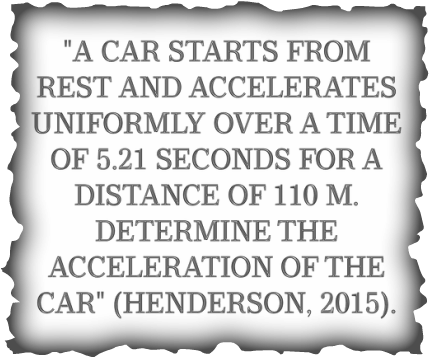
Use what you just learned about selecting a strategy to determine what strategies could be useful in solving this. Do you remember what type of problem this is? This could help you determine whether you should use an algorithm or heuristic. What physics concepts do you think apply here? |
